What does CPM mean?
CPM stands for cost per mille, or cost per one thousand impressions. It expresses advertising cost in standardized blocks of 1,000 impressions, making campaigns with different impression totals easier to compare on the same basis.
An impression is an exposure counted by the advertising platform. CPM focuses on those impressions rather than clicks, conversions or revenue.
CPM formula
The formula is: total campaign cost divided by total impressions, multiplied by 1,000.
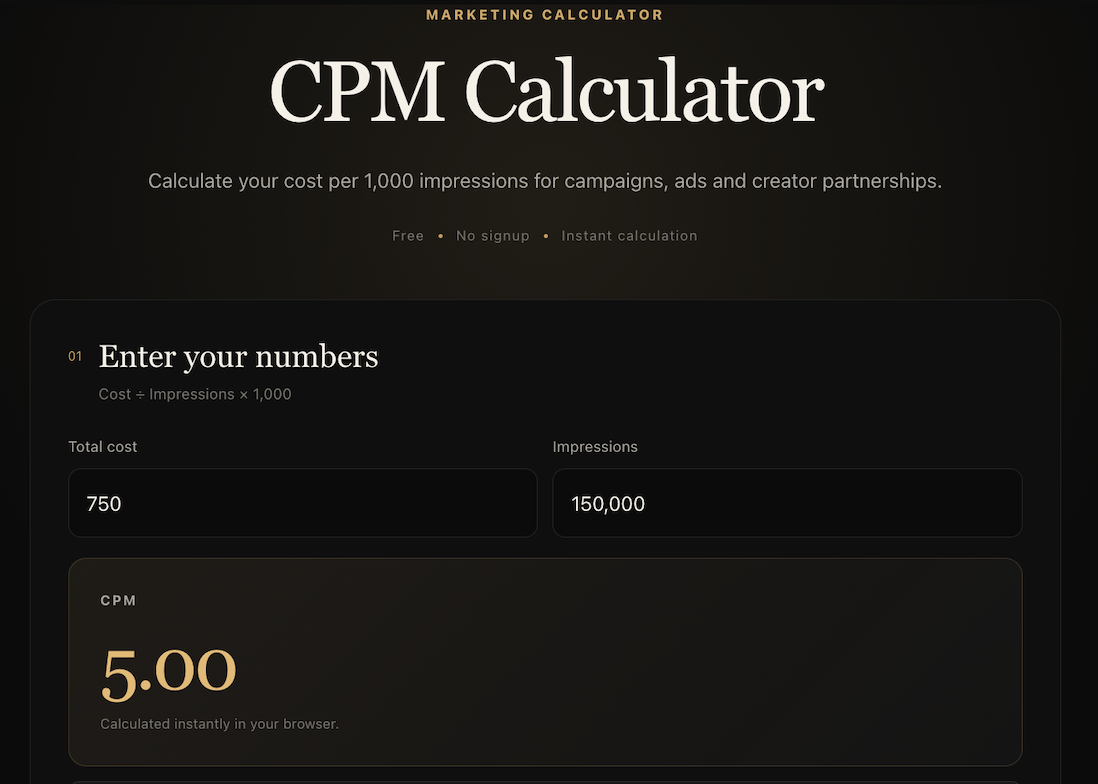
Suppose a campaign costs $750 and receives 150,000 impressions. Divide 750 by 150,000, then multiply by 1,000. The CPM is $5.
- CPM = cost ÷ impressions × 1,000.
- $750 ÷ 150,000 × 1,000 = $5 CPM.
- Enter the full impression count, not the number of thousands.
Another CPM example
Imagine two campaigns. Campaign A costs $400 for 50,000 impressions, giving it an $8 CPM. Campaign B costs $600 for 100,000 impressions, giving it a $6 CPM.
Campaign B has the lower cost per 1,000 impressions even though its total spend is higher. That illustrates why standardized metrics can be more useful than comparing spend alone.
What CPM does not tell you
CPM does not tell you how many people clicked, bought something or became customers. It measures cost against impressions.
If clicks matter, calculate CPC as well. If you are evaluating attributed revenue relative to advertising spend, ROAS addresses a different question.
Common CPM calculation mistakes
One common error is entering impressions in thousands and then multiplying by 1,000 again. If your report says 125,000 impressions, use 125,000 in the standard formula.
Also make sure the spend and impressions cover the same campaign and reporting period. Mixing numbers from different date ranges produces a result that is mathematically valid but analytically misleading.